What the UN Security Council Does — and How the Veto Works
The Security Council is the UN's most powerful body, where any one of five permanent members can block a major decision on its own with the veto.

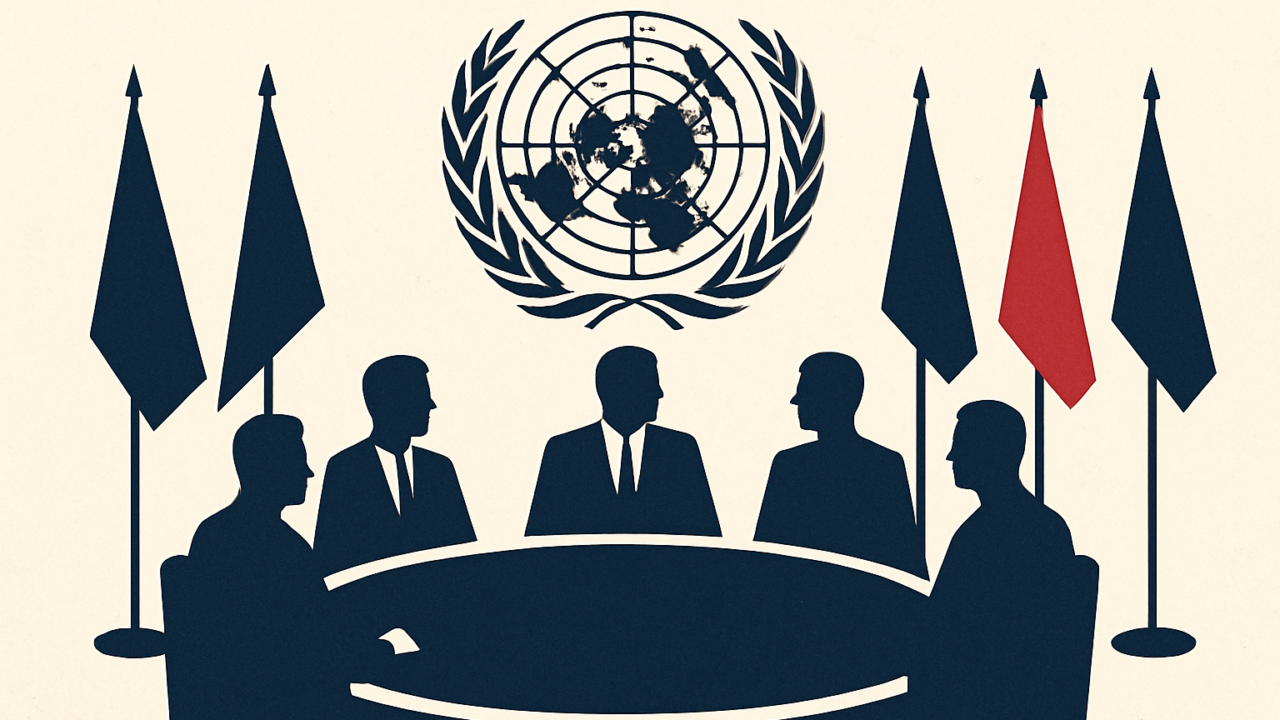
The United Nations Security Council is the only part of the UN system that can make decisions all member states are legally bound to obey. While the General Assembly can debate and recommend, the Council can compel — and at the centre of how it works sits a single, much-debated power: the veto held by its five permanent members.
Understanding the Council means understanding two things at once: what it is allowed to do, and why a single "no" vote from the right country can stop it cold.
What the Council is responsible for
Under the UN Charter, the Security Council carries what the document calls "primary responsibility for the maintenance of international peace and security." In practice, that gives it a set of tools no other UN body has.
- It can investigate disputes and call on countries to settle them peacefully.
- It can impose economic sanctions, arms embargoes and travel bans.
- It can authorise peacekeeping operations.
- In the most serious cases, it can authorise the use of force.
Decisions of this kind are binding on all UN members, not just the countries sitting on the Council. That is what makes the body distinctive. A General Assembly resolution carries political and moral weight; a Security Council resolution carries the force of international law.
Who sits on the Council
The Council has fifteen members. Five of them are permanent: China, France, Russia, the United Kingdom and the United States — often called the P5. These were the principal victorious powers at the end of the Second World War, when the UN was founded in 1945, and their permanent seats reflect the political settlement of that moment. Russia’s seat was previously held by the Soviet Union, which it succeeded.
The remaining ten seats are non-permanent. They rotate among the wider membership, with countries elected by the General Assembly to serve fixed terms, allocated to ensure representation across the world’s regions. These elected members vote on everything the Council does, but they do not hold the veto.
How a decision passes — and how the veto works
The voting rules are set out in Article 27 of the Charter, and they draw a line between two kinds of business. Procedural matters — questions about how the Council organises its own work — can pass with the affirmative votes of any nine of the fifteen members. On these, all members are equal.
Everything more consequential is treated as a substantive matter: sanctions, peacekeeping, the authorisation of force. These also require nine affirmative votes, but with an added condition. They need what the Charter calls the "concurring votes of the permanent members." In effect, this means a single negative vote from any one of the five permanent members blocks the resolution — even if the other fourteen members support it. That is the veto.
The word "veto" does not actually appear in the Charter. The power flows from that requirement for permanent-member concurrence in Article 27.
A single "no" from one permanent member is enough. A resolution can have overwhelming support and still fail.
The crucial detail: abstention is not a veto
One point is frequently misunderstood. A permanent member that does not want to support a resolution, but does not want to block it either, can abstain or be absent. By long-established practice, an abstention does not count as a veto. If the resolution still collects nine affirmative votes, it passes. This allows a P5 member to register disapproval without halting action entirely, and it has shaped many of the Council’s decisions over the decades.
Because of this, the influence of the veto extends well beyond the votes that are formally cast. When a permanent member signals privately that it intends to vote no, a draft resolution is often withdrawn or softened before it ever reaches a public vote. This quieter form of the veto leaves no record but can be just as decisive.
Why the structure is so hard to change
The P5 arrangement has long drawn criticism. Some argue it reflects the geopolitics of 1945 rather than the present, and proposals to add new permanent members or to restrain the veto in cases of mass atrocity have circulated for years. France, among the permanent members, has publicly supported the idea of voluntary restraint.
Yet reform is structurally difficult, by design. Amending the Charter itself requires the agreement of the permanent members. In other words, the same five countries that hold the veto would have to consent to limiting it — which gives each of them an effective veto over any attempt to change the veto. That circularity, more than anything, explains why the Council looks much as it did when it was created.

Margaret Ellison
Margaret Ellison is the editor-in-chief of Tilias News. She leads the newsroom's coverage of world affairs and oversees editorial standards across every section, with a focus on clear, sourced reporting that respects the reader's time.


