End-to-End Encryption: What It Protects, and What It Doesn’t
End-to-end encryption keeps the contents of your messages private in transit. It is powerful, and it is also narrower than many people assume.

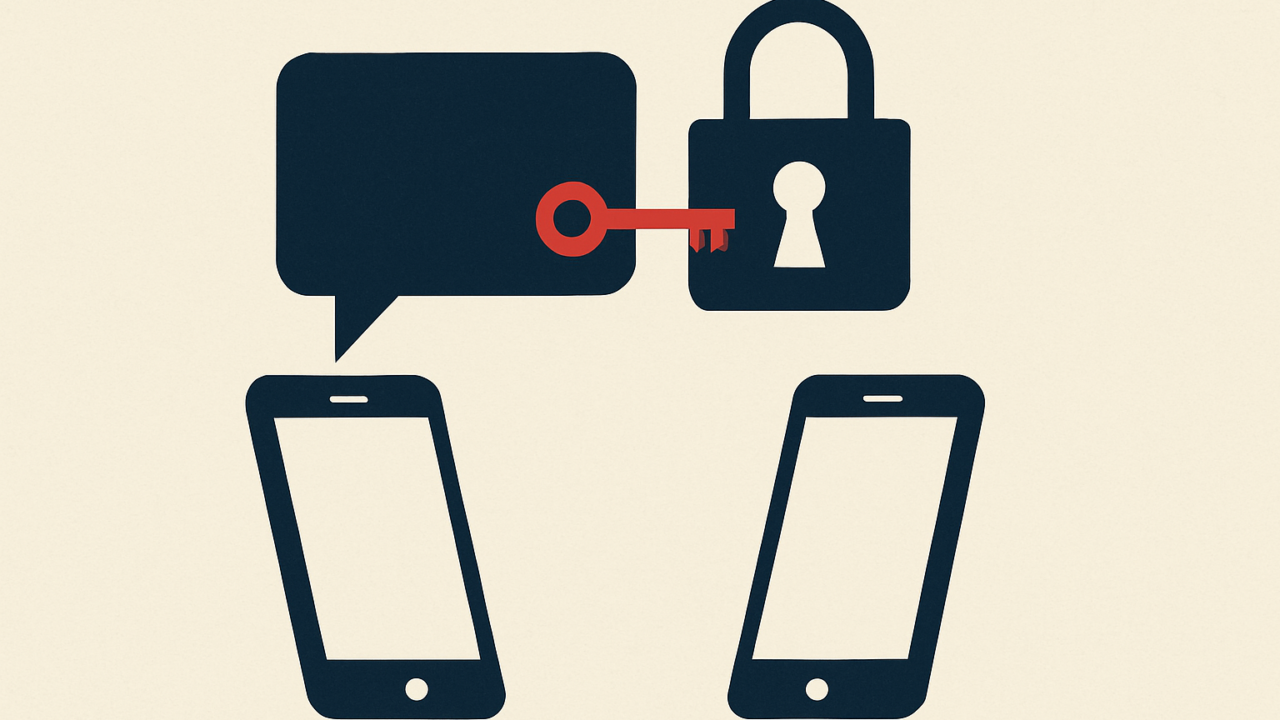
The phrase shows up on messaging apps, in privacy debates, and in app store descriptions: end-to-end encrypted. It signals that your conversations are private. But private from whom, and protected how? The answer is precise, and the precision matters.
End-to-end encryption, often shortened to E2EE, is a method of scrambling a message so that only the sender and the intended recipient can read it. Not the app maker, not the network carrier, not anyone who intercepts the data along the way.
How the scrambling works
Encryption turns readable text into ciphertext using a mathematical key. Without the right key, the ciphertext is meaningless. The question that defines any encryption scheme is: who holds the keys?
In end-to-end encryption, the keys live only on the devices at each end of the conversation. Your phone encrypts a message before it leaves, and only the recipient’s device holds the matching key to unscramble it. The service that carries the message moves sealed envelopes it cannot open.
Most modern systems use public-key cryptography to make this practical. Each device has a public key it shares freely and a private key it never reveals. Anyone can use your public key to encrypt a message to you, but only your private key can decrypt it. This solves the hard problem of agreeing on a secret without ever transmitting that secret in the open.
The contrast that makes this clearer is the older approach, sometimes called encryption in transit. Many services encrypt a message between your device and their servers, then decrypt it on the server, store or process it, and re-encrypt it onward to the next person. That protects against an outside eavesdropper but leaves the contents readable by the service in the middle. End-to-end encryption removes that middle reader entirely, so the provider relays sealed data it has no way to open.
What E2EE actually protects
When implemented well, end-to-end encryption protects the contents of your communication from everyone except the people in the conversation. That is a strong guarantee, and it holds against some powerful adversaries:
- The company operating the service cannot read your messages, even if compelled to hand over what it stores.
- An attacker who intercepts traffic on a network, including public Wi-Fi, sees only ciphertext.
- Someone who breaches the provider’s servers finds scrambled data, not readable conversations.
This is why security and privacy experts regard E2EE as a meaningful protection for sensitive communication. The Signal protocol, which underpins several widely used messaging apps, is a well-known and openly documented example of the approach.
Strong systems also give users a way to confirm they are talking to the right person and not an impostor sitting in the middle. Some apps expose a verification code, sometimes called a safety number or a key fingerprint, that two people can compare in person or through a separate trusted channel. If the codes match, the connection has not been tampered with. It is an optional step, but it closes one of the few remaining gaps in the channel itself.
What E2EE does not protect
Here is where expectations and reality often diverge. End-to-end encryption secures a message in transit between two devices. It does not secure much else, and the gaps are where most real-world risk lives.
Encryption protects the message on the wire. It does nothing for a message already sitting unlocked on a screen.
Consider the limits honestly:
- The endpoints themselves. If someone has access to your unlocked phone, or has installed spyware on it, encryption is irrelevant. They read the message after it is decrypted, exactly as you do.
- Metadata. Encryption typically hides what you said, not that you said it. Who you contacted, when, and how often can still be visible, and that pattern can be revealing on its own.
- Backups. If your messages are backed up to a cloud service without end-to-end encryption, the backup may be readable even when the live chat is not. Backup settings deserve a careful look.
- The other person. Anyone you message can screenshot, copy, forward, or simply show your conversation to someone else. Encryption never controls what a legitimate recipient does next.
How to think about it
Treat end-to-end encryption as a strong lock on the channel between two devices, not as a guarantee of total secrecy. It closes off the network and the service provider as points of exposure, which is genuinely valuable. It leaves the devices, the metadata, the backups, and the people open.
For ordinary use, a few habits make the lock worth more:
- Keep your devices updated and protected with a strong screen lock, because the endpoints are the weak point.
- Check whether your message backups are themselves encrypted, and adjust if they are not.
- Remember that anything you send can be saved by the other side, regardless of how it was protected in transit.
Used with those limits in mind, E2EE is one of the more effective privacy tools available to ordinary people. The mistake is treating it as a force field rather than what it is: a very good lock on one specific door.

Marcus Reed
Marcus Reed reports on technology for Tilias News — artificial intelligence, consumer products, platforms and the rules that govern them. He focuses on what new tools actually change for ordinary people.


