How Solar Panels Turn Sunlight Into Electricity
Inside the photovoltaic effect: how a slab of treated silicon converts light into usable electric current, with no moving parts.

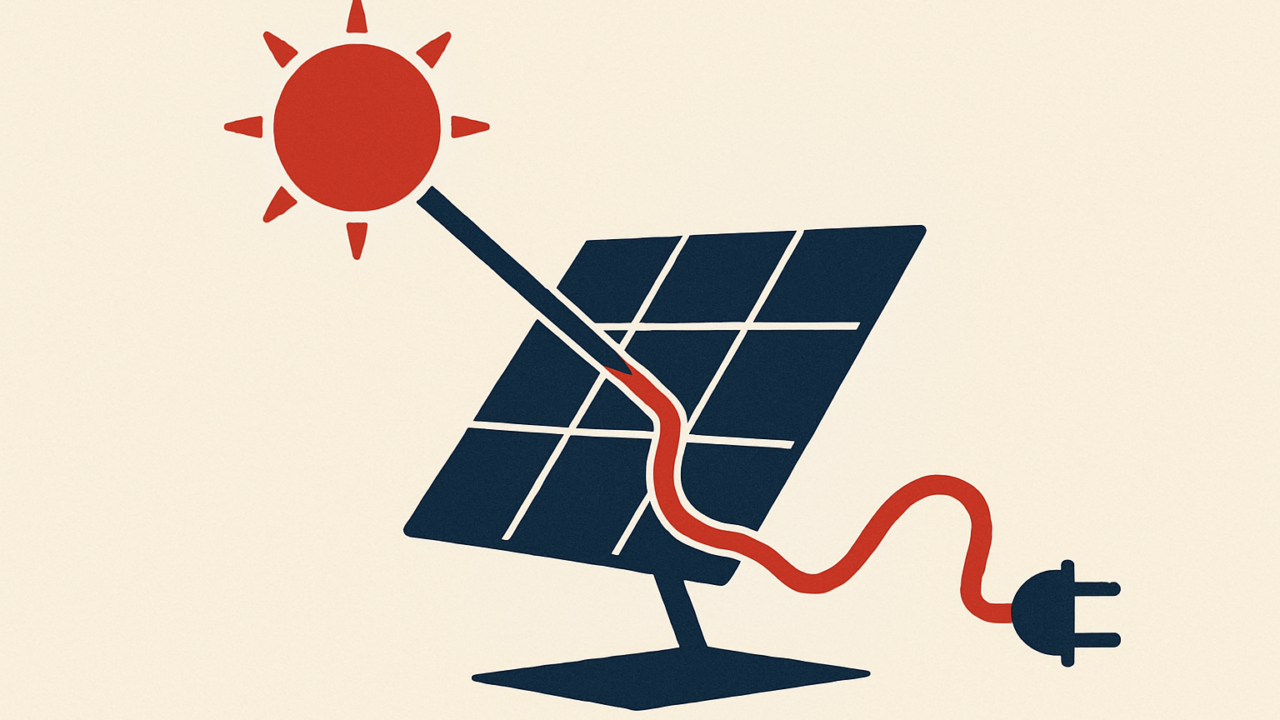
A solar panel has no engine, no fuel, and no moving parts, yet it produces electricity whenever light falls on it. The device works because of a property of certain materials, discovered in the 19th century, called the photovoltaic effect. Understanding that effect explains both what solar panels can do and where their limits lie.
The building block: a solar cell
The panel you see on a roof is made of many smaller units called solar cells, wired together and sealed under glass. Most cells today are made from silicon, the same abundant element used in computer chips. A single cell produces only a small voltage, so dozens are connected in series to make a panel, and panels are connected to form an array.
The heart of each cell is a thin wafer of silicon that has been deliberately treated, or doped, with small amounts of other elements. This treatment creates two layers with different electrical properties: one layer with a slight surplus of electrons and one with a slight deficit. Where the two layers meet, they form a junction with a built-in electric field. That field is the engine of the whole device.
The photovoltaic effect
Light can be thought of as a stream of energy packets called photons. When a photon of sufficient energy strikes the silicon, it can knock an electron loose from its atom, leaving behind an empty space, or hole. On its own, that freed electron would simply settle back down and the energy would be lost as heat.
This is where the junction matters. The built-in electric field pushes the freed electrons in one direction and the holes in the other. That separation creates a voltage difference across the cell. As the U.S. Department of Energy describes it, the photovoltaic effect is the process of generating voltage and current when a material is exposed to light.
Connect a wire between the two sides and the separated electrons flow through it to recombine on the far side. That flow of electrons through an external circuit is electric current — usable electricity. As long as light keeps arriving, the current keeps flowing.
From cell to home
A solar cell produces direct current, or DC, the same kind of electricity stored in a battery. Most homes, appliances, and the electric grid run on alternating current, or AC. So a panel cannot power a house by itself.
The missing piece is an inverter, a device that converts the panel’s DC output into grid-compatible AC. A typical rooftop system therefore includes:
- Panels that generate DC electricity from light.
- An inverter that converts DC to AC.
- A meter and connection to the home’s wiring and often the grid.
- Optional battery storage to hold energy for use after dark.
When a grid-connected system produces more than the home needs, the surplus can flow back to the grid; when it produces less, the home draws from the grid as usual.
Why efficiency and conditions matter
No solar cell converts all the light that hits it into electricity. Some photons carry too little energy to free an electron; some carry more than is needed and the excess becomes heat; and some light is reflected or passes through. As a result, commercial silicon panels typically convert only a portion of the sunlight reaching them into electricity, with the rest lost mostly as heat. Decades of engineering have steadily raised that conversion figure, but physical limits keep it well below 100 percent.
Output also depends on conditions outside the cell. Panels produce the most power under direct, intense sunlight and less under clouds or at low sun angles. They generate nothing at night, which is why storage or a grid connection is needed for round-the-clock supply. Counterintuitively, very high temperatures slightly reduce a panel’s efficiency, so a cool, bright day can outperform a scorching one.
Despite these limits, solar has moved from a niche product to a mainstream source of power. The International Energy Agency reports that solar photovoltaics has become one of the fastest-growing sources of electricity worldwide, driven by steep declines in the cost of panels over the past decade. The underlying science, however, has not changed: every one of those panels still works by using light to knock electrons loose and a built-in electric field to put them to work.
The bottom line
A solar panel is, at its core, a light-driven electron pump with no moving parts. Photons free electrons inside treated silicon, an internal electric field separates the charges, and a wire carries the resulting current to where it is needed. An inverter makes that current usable in a home, and storage or the grid covers the hours when the Sun is down.

Margaret Ellison
Margaret Ellison is the editor-in-chief of Tilias News. She leads the newsroom's coverage of world affairs and oversees editorial standards across every section, with a focus on clear, sourced reporting that respects the reader's time.


