The Greenhouse Effect, Explained
How a thin blanket of gases keeps Earth warm enough to live on — and why adding more of them is changing the climate.

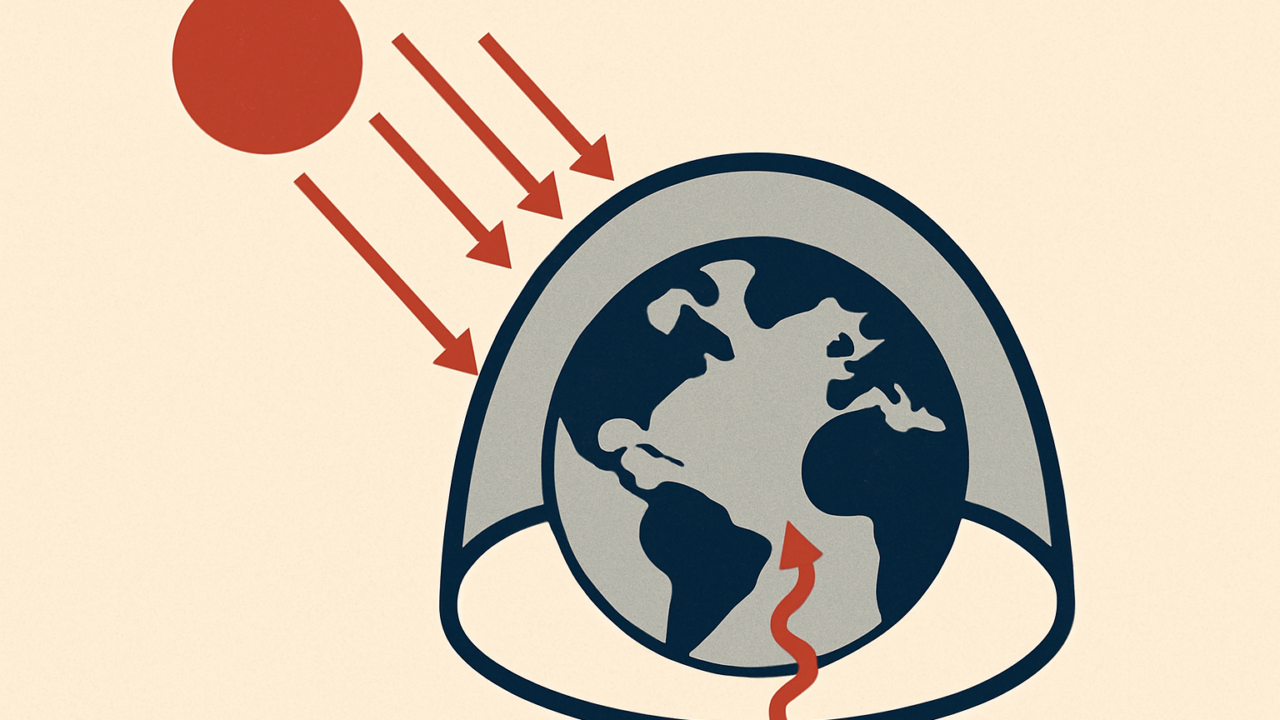
Without an atmosphere, Earth would be a frozen rock. The planet’s average surface temperature would sit far below freezing, and liquid water — the basis of life as we know it — would be scarce. The reason it is not is a natural process called the greenhouse effect, which traps a portion of the Sun’s energy near the surface and keeps the planet roughly 33 degrees Celsius warmer than it would otherwise be. Understanding how that process works is also the key to understanding why the climate is now warming.
How the effect works
The process starts with sunlight. Energy from the Sun arrives mostly as visible light, which passes through the atmosphere and warms the land and oceans. The warmed surface then radiates that energy back toward space, but in a different form: invisible infrared, or heat, radiation.
Here is the crucial step. Certain gases in the atmosphere are nearly transparent to incoming sunlight but absorb outgoing infrared radiation. They take in that heat and re-emit it in all directions, including back down toward the surface. The result is that the lower atmosphere and the ground stay warmer than they otherwise would. NASA describes this as the mechanism that makes Earth habitable.
The name is something of a misnomer. A glass greenhouse stays warm mainly by physically trapping warm air and blocking convection. The atmospheric effect works through the absorption and re-emission of radiation. The analogy is imperfect, but the label has stuck.
Which gases are responsible
Not every gas in the air contributes. Nitrogen and oxygen, which together make up most of the atmosphere, are largely transparent to infrared radiation. The gases that matter are present in much smaller amounts but are powerful absorbers. The main ones are:
- Water vapor — the most abundant greenhouse gas, though its amount is largely a response to temperature rather than a primary driver.
- Carbon dioxide (CO2) — released by burning fossil fuels, deforestation, and some industrial processes, and the principal long-lived driver of recent warming.
- Methane (CH4) — from agriculture, livestock, landfills, and fossil-fuel extraction; far less abundant than CO2 but more potent per molecule.
- Nitrous oxide and certain industrial gases — smaller contributors but long-lived and potent.
A natural greenhouse effect has operated for billions of years and is entirely beneficial. The concern is not the effect itself but its intensification.
Why adding gases matters
When more heat-trapping gas enters the atmosphere, more outgoing infrared radiation is absorbed and the surface warms in response. According to NOAA’s monitoring, the atmospheric concentration of carbon dioxide has risen substantially since the Industrial Revolution, and is now well above the range seen across hundreds of thousands of years of ice-core records.
The IPCC, the United Nations body that assesses climate science, states the conclusion plainly:
It is unequivocal that human influence has warmed the atmosphere, ocean and land.
Carbon dioxide is central to the story because it is both abundant and long-lived. A portion of the CO2 released today can influence the climate for centuries, which is why cumulative emissions, not just current ones, shape the long-term outcome.
Feedbacks make the system complex
The climate does not respond in a simple straight line. Warming triggers feedbacks that can amplify or, in some cases, dampen the initial change. Warmer air holds more water vapor, and because water vapor is itself a greenhouse gas, this tends to amplify warming. Melting ice exposes darker land and ocean, which absorb more sunlight than reflective white surfaces, adding further warming.
Other parts of the system absorb heat and slow the pace of surface change. The oceans take up a large share of the extra energy, and plants and soils absorb some of the added carbon. These buffers moderate warming but do not stop it, and some have limits.
This complexity is why scientists rely on physical models and long observational records rather than intuition. The basic physics of how greenhouse gases absorb infrared radiation has been understood since the 19th century and is not in scientific dispute; the active research questions concern the precise size, speed, and regional distribution of the changes.
The bottom line
The greenhouse effect is a natural and necessary feature of a living planet. Earth is comfortable because its atmosphere holds onto heat. What has changed is the concentration of the gases that do the holding. By adding carbon dioxide and other heat-trapping gases faster than natural processes remove them, human activity has strengthened a process that would otherwise be in balance. A warmer surface is the direct, well-understood consequence — and because the gases driving it are long-lived, the choices made about emissions today shape the climate for generations to come.

Margaret Ellison
Margaret Ellison is the editor-in-chief of Tilias News. She leads the newsroom's coverage of world affairs and oversees editorial standards across every section, with a focus on clear, sourced reporting that respects the reader's time.


